Posts

DFI- Enabling Access

Sharing teaching and learning with children, (or Visible Learning) is a relatively new concept. Not something I was lucky enough to have in my own education. Now, students can access their learning autonomously, anywhere, anytime. For most children, this is a real driver in their success as a learner. The Manaiakalani view on Visible Learning takes this concept even further... teaching and learning is visible for not only students but for whānau and colleagues as well. A great example of this is the Hapara Parental Portal- basically a way to share students' 'books' with their parents directly. Using Google sites is a way of sharing planning to children and whānau. In our hub we have begun a site and the process of making our teaching more visible. This is a work in progress. Today I built a Digi-club site so students could do rewind learning and access the resources for Tahi Rua Toru Tech club. https://sites.google.com/view/marshlanddigiclub I can really see the v...

Collaborate- sites

I was absent for this DFI but from reading through what was covered, multi-modal was introduced. I have just begun to use multimodal in my literacy planning- where I try to make tasks engaging for my students by adding pictures, clips and links to take them elsewhere. I made this decision based on some of the examples of planning shared with us in this course. I felt engaged with the material and so I felt that my students would be too. I plan on introducing children to sites so I am pleased that next week's session runs on from this one.

Dealing with Data

Image
This week in our DFI we learned all about Google Forms, Google Maps and Google Sheets. Google Forms are a great way to gather student pre and post data about a topic or gather feedback about an area you have taught. I like the idea of using Forms to collect student names and year levels for extracurricular activities or workshops and then having the Form collate the responses into a Google Sheet. What a time saver! In Google Maps we learned how to layer different locations, even using the information gathered in a Google spreadsheet to do this. I can see advantages to using Maps in Maths, particularly for area and also it could be used in a lot in Inquiry or Reading so students can think about context.  The Google Sheets aspect of today's session was particularly useful for analysing blog posts and is something I hope to use this week in class as a challenge to students. Can they better their number of 2018 blog posts by halfway through this year? Today we foc...

DFI- Work Flow

Work/Life balance is especially hard to find as a teacher (and as a teaching parent!).  Today's session was all about Work Flow. How can we use the G suite to make our life any easier on a daily basis?  Google Keep is a great way of keeping notes, reminders and sites all in one place. Taking a photo of text and then converting it is a very useful tool to share this text with students digitally. On a personal level, Google Keep will be great as the tasks and lists that I have made, will send reminders either during a scheduled time or even when I go near a location that I have saved! There will never be a forgotten shopping list item or email again!   As a teacher in a collaborative learning environment, we have to constantly be meeting and recording our minutes. I plan to introduce my colleagues to Google Hangouts so that as teachers are away or we would like to meet with our part-time teacher, we can have meetings whenever/where ever. Another g...

DFI Core Business

Image
One thing that strikes a chord for me about the Manaiakalani kaupapa and pedagogy was the origin.  It was designed for priority learners that came from socio-economic backgrounds that historically our education system has failed. Research shows improved and even accelerated progress using the LEARN, CREATE, SHARE model. This tells me that if this model creates success for these learners it will create success for all learners.  Our Core Business session covered the origins of Manaiakalani and went deeper into tips using Drive & Docs. Many of the things we covered today are already being used by students and staff at Marshland School but it was great to consolidate any new learnings with what I already knew.  

Changes in Practice

A good educator will change and adapt their practice to suit the needs of their individual learners. They will also keep up with changes in the educational sector at a global level. They will continue their professional development actively, knowing that they need themselves to be life-long learners, in order to teach this to their students. They know that their students need to be 21st century learners in order to succeed in the world beyond school, therefore they adapted their teaching before 21st century skills even came up for debate. Most importantly, good educators reflect upon their teaching and their learning and they are self-aware. Self-awareness is the key to being a good educator, a great educator in fact.  Over the last 8 weeks, I have reflected over different topics within the educational sector and I have found that it has not only consolidated my ideas and opinions but given me the keys to being able to describe my thoughts and views in a clearer way....

Interdiscipinary Connections

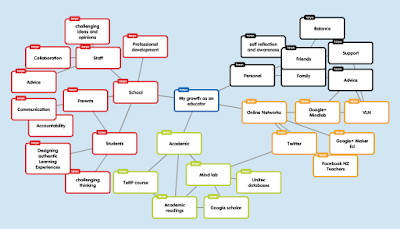
Image
My interdisciplinary connection map (created with Popplet) shows the connection between developing knowledge, points of view and support from others, and experiences. All together this shapes my learning experiences as an educator. I need all the aspects in order for my learning experiences to be authentic and therefore I am able to take my learning back to my daily life and apply it. If this is how MY learning is shaped, then you can see the need for interdisciplinary learning within the classroom.   From my map, there are a couple of areas I need to work harder on in order to keep my growth as an educator going. In fact, there will ALWAYS be areas to improve on... perhaps this is what makes a life long learner! Firstly, I need to become better at interacting online so I am consistently engaging with fellow educators and therefore continually developing my knowledge based on my own and others' points of view, receiving and sharing of new and exciting ideas ...